The Complete Guide to LLM API Pricing in 2026: Every Model, Every Provider, One Table
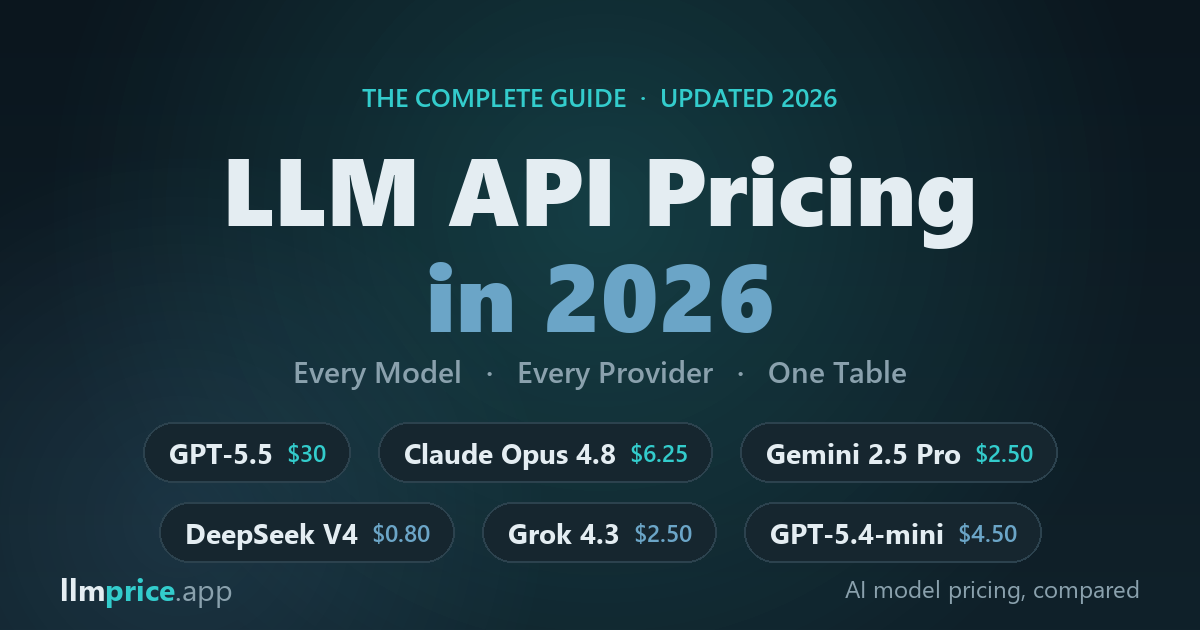
Two years ago, choosing an LLM API meant choosing between OpenAI and, well, OpenAI. In 2026 the board looks nothing like that. You have three frontier labs trading benchmark leads month to month, a Chinese open challenger that undercuts everyone by an order of magnitude, and a middle tier so crowded that the "good enough" models are now genuinely good. The problem is no longer scarcity of options — it is that the pricing is a mess of input rates, output rates, context tiers, and reasoning surcharges that make apples-to-apples comparison almost impossible at a glance.
This guide fixes that. Below is every major model worth considering in 2026, sorted into three price tiers, with the one framing that actually predicts your bill — the split between what you pay to read and what you pay to write. Every number is drawn from llmprice.app's live data, which tracks official provider rates. Let's get into it.
First, the only pricing concept that matters
LLM APIs bill in tokens — roughly ¾ of a word each — and they bill input and output separately. Input tokens are everything you send: the prompt, the system instructions, the document you pasted, the conversation history. Output tokens are what the model generates back.
Here is the trap almost everyone falls into: they compare models on one number. But output is routinely 4x to 8x more expensive than input, and different workloads have wildly different input-to-output ratios. A summarizer reads 50,000 tokens and writes 500. An agent reads 2,000 and writes 10,000. Those two jobs have opposite cost profiles, and a model that is cheap for one can be ruinous for the other. Any pricing comparison that gives you a single "price per model" is lying to you by omission. Hold on to the two-number habit for the entire rest of this guide.
Tier 1: Flagship ($5+ per 1M output)
The models you reach for when quality is non-negotiable — frontier reasoning, hard coding, anything customer-facing where a wrong answer is expensive.
| Model | Input / 1M | Output / 1M | Quality | Context |
|---|---|---|---|---|
| GPT-5.5 (OpenAI) | $5.00 | $30.00 | 97 | 1,049K |
| Claude Fable 5 (Anthropic) | $10.00 | $50.00 | 96 | 200K |
| GPT-5.4 (OpenAI) | $2.50 | $15.00 | 92 | 1,049K |
| Claude Opus 4.8 (Anthropic) | $5.00 | $6.25 | 94 | 200K |
| Gemini 3.1 Pro (Google) | $2.00 | $4.00 | 91 | 1,049K |
| o3 (OpenAI) | $2.00 | $8.00 | 95 | 200K |
The story of this tier in 2026 is the collapse of the "premium output" premium. Look at the two Anthropic entries: Claude Fable 5 charges $50 per million output tokens for a 96 quality score, while Claude Opus 4.8 delivers a 94 for $6.25 — eight times cheaper output for two fewer points. Unless you have a specific reason to need Fable 5's edge, Opus 4.8 is one of the best value propositions on the entire board: near-frontier quality at mid-tier pricing. GPT-5.5, meanwhile, commands $30 output because it pairs a 97 with a million-token context window — a combination nothing else offers. Pay for it when you need the context; skip it when you don't.
Tier 2: Mid-range ($1–$5 per 1M output)
The workhorse tier — where most production traffic should probably live. Quality in the high 80s to low 90s at a fraction of flagship cost.
| Model | Input / 1M | Output / 1M | Quality | Context |
|---|---|---|---|---|
| Gemini 2.5 Pro (Google) | $1.25 | $2.50 | 93 | 1,049K |
| Claude Sonnet 4.6 (Anthropic) | $3.00 | $3.75 | 90 | 200K |
| Grok 4.3 (xAI) | $1.25 | $2.50 | 89 | 131K |
| GPT-5.4-mini (OpenAI) | $0.75 | $4.50 | 85 | 1,049K |
| o4-mini (OpenAI) | $1.10 | $4.40 | 88 | 200K |
| GLM-5.2 (Zhipu) | $0.91 | $2.86 | 88 | 128K |
This is the most interesting tier in 2026, because the quality ceiling has risen so far that many teams paying flagship prices are simply overspending out of habit. Gemini 2.5 Pro is the standout: a 93 quality score — matching Claude Opus 4.6 — with a million-token context window, for $2.50 output. That is flagship capability at mid-range pricing, and for a huge swath of production work it is the rational default. Claude Sonnet 4.6 is the value pick if you want Anthropic's coding pedigree without Opus money, and Grok 4.3 quietly matches Gemini's output price at a respectable 89.
Tier 3: Budget (under $1 per 1M output)
High volume, latency-sensitive, or cost-obsessed workloads — classification, routing, simple chat, batch pipelines.
| Model | Input / 1M | Output / 1M | Quality | Context |
|---|---|---|---|---|
| DeepSeek V4 (DeepSeek) | $0.20 | $0.80 | 88 | 131K |
| DeepSeek Reasoner V4 | $0.44 | $0.87 | 92 | 131K |
| Gemini 2.5 Flash (Google) | $0.50 | $0.50 | 84 | 1,049K |
| Groq Llama 3.3 70B | $0.59 | $0.79 | 78 | 128K |
| Claude Haiku 4.5 (Anthropic) | $1.00 | $1.25 | 82 | 200K |
| Phi-4 (Microsoft) | $0.07 | $0.14 | 76 | 16K |
The headline of the budget tier — and arguably of 2026 pricing overall — is DeepSeek. DeepSeek V4 posts an 88 quality score for $0.80 output. Put that next to GPT-5.5's 97 for $30 and the math becomes almost absurd: you are giving up 9 quality points to pay 37 times less for output. For any task where an 88 is acceptable — and that is most tasks — DeepSeek reframes the entire cost conversation. Its Reasoner variant even climbs to a 92, matching mid-tier reasoning models for well under a dollar. Gemini 2.5 Flash deserves a nod too: flat $0.50 in and out, with the same million-token context as its Pro sibling.
The number that isn't on the price sheet: context
Two models can have identical per-token prices and wildly different real costs, because context window changes how many tokens you send in the first place. A retrieval-augmented app that stuffs 100K tokens of documents into every request pays for those 100K input tokens on every single call. Choose a small-context model and you are forced to chunk and make multiple calls; choose a million-token model and you might do it in one — but you pay to re-read that giant context each turn.
The practical rule: a large context window is a capability, not a discount. Gemini's 1,049K and GPT-5.5's 1,049K let you do things a 128K model cannot, but they also make it easy to run up a bill by over- stuffing prompts. Right-size your context to the task, and use prompt caching (offered by every major provider in 2026) to avoid paying full input price for the same system prompt on every call.
Which model for which job
| Use case | Recommended | Why |
|---|---|---|
| Frontier coding agent | Claude Opus 4.8 | Top-tier code, cheap $6.25 output |
| Whole-codebase / huge docs | GPT-5.5 or Gemini 2.5 Pro | 1M-token context windows |
| High-volume chat | Gemini 2.5 Flash | $0.50 flat, million-token context |
| Cheapest capable model | DeepSeek V4 | 88 quality for $0.80 output |
| Best all-round value | Gemini 2.5 Pro | 93 quality, $2.50 output, 1M context |
| Classification / routing | Phi-4 or Gemini 2.5 Flash | Pennies per million tokens |
The bottom line for 2026
The single most important shift this year is that the price-quality frontier has flattened. The gap between a 97 and an 88 is now small enough that, for most real workloads, the deciding factor is not "which model is smartest" but "which model is smart enough, cheapest." The teams overspending in 2026 are almost always the ones defaulting to a flagship because it is famous, when a mid-tier or budget model would clear their quality bar at a tenth of the cost.
Two habits will keep your bill honest. First, always compare on both input and output price, weighted by your actual token mix — never a single headline number. Second, benchmark down, not up: start with the cheapest model that might work and only move up a tier when you can measure a quality problem. To make either easy, keep the live comparison table and the cost calculator open while you decide.
Turn these tables into your real monthly bill
Enter your input and output token volumes and compare every model's actual cost for your workload.
Open the cost calculatorFrequently asked questions
Why do LLM APIs charge different prices for input and output?
Generating tokens is more computationally expensive than reading them, so providers price them separately — output is typically 4x to 8x the input rate. Because workloads differ in their input-to-output ratio, you must weigh both numbers against your actual usage rather than comparing a single price.
What is the best-value LLM API in 2026?
For all-round value, Gemini 2.5 Pro stands out: a 93 quality score, a million-token context window, and $2.50 output pricing. For rock-bottom cost, DeepSeek V4 delivers an 88 quality score for $0.80 output — roughly 37x cheaper output than GPT-5.5.
How does context window size affect cost?
A larger context window doesn't lower the per-token price, but it changes how many tokens you send. Big-context models let you process huge documents in one call, but you pay input price for that entire context on every turn — so right-size your prompts and use prompt caching for repeated content.
Do I need a flagship model like GPT-5.5?
Usually not. In 2026 the quality gap between flagship (95+) and mid-tier (88-93) models is small enough that most production workloads are well served by a cheaper tier. Reserve flagships for tasks that genuinely need frontier quality, a million-token context, or audio.
Further reading: GPT-5.5 vs Claude Opus 4: The $30 Question · Cheapest LLM APIs in 2026