GPT-5.5 vs Claude Opus 4: The $30 Question — Is OpenAI's Priciest Output Token Worth It?
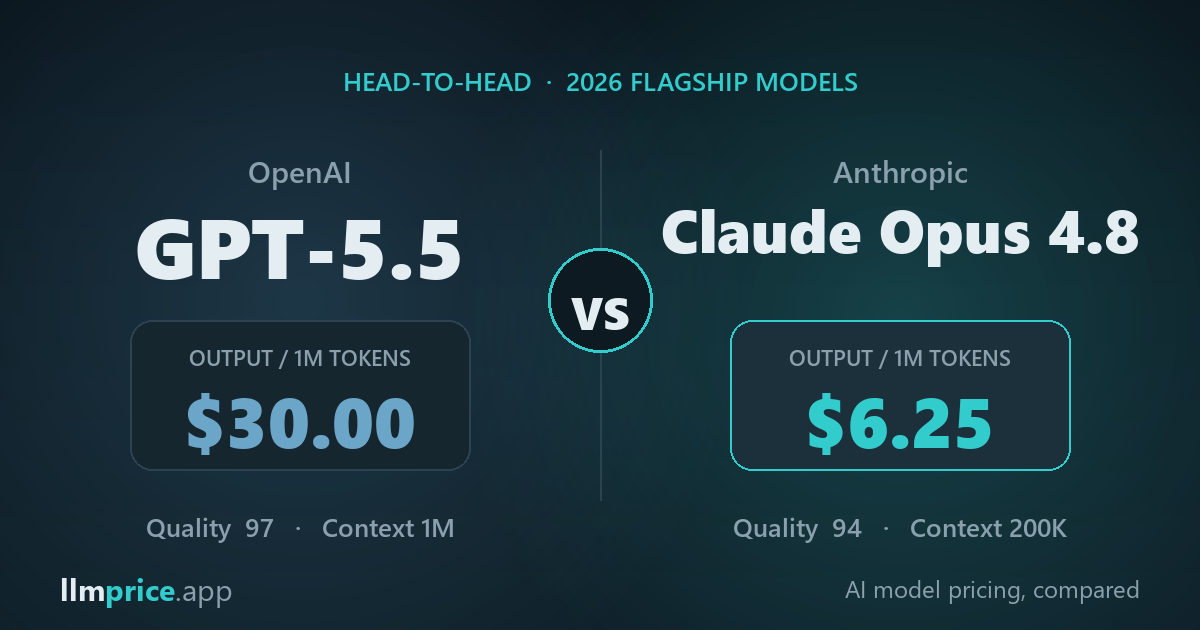
Here is a number that should stop any engineering lead mid-scroll: $30. That is what OpenAI charges for one million output tokens on GPT-5.5, its flagship model for 2026. Anthropic charges $6.25 for the same million output tokens on Claude Opus 4.8. Both models sit in the same benchmark neighborhood. Both are billed as the smartest thing their maker ships. And yet one of them costs almost five times as much to talk back to you.
The reflex is to assume the pricier token is the better token — that OpenAI has simply priced in a quality premium the market will bear. But the premium is not five times more quality. It is, on the composite benchmark score llmprice.app tracks, exactly three points: 97 versus 94. So the real question is not "which model is better?" It is "is a 3-point quality edge worth paying a 380% output premium for?" The answer, for most teams, is no. But the exceptions are worth understanding, because they are exactly where GPT-5.5 earns its price tag.
The tale of the tape
Let's put the two models side by side. All prices are USD per million tokens; the quality score is a composite benchmark rating out of 100; speed is approximate output tokens per second.
| Metric | GPT-5.5 | Claude Opus 4.8 |
|---|---|---|
| Provider | OpenAI | Anthropic |
| Quality score | 97 | 94 |
| Input price / 1M | $5.00 | $5.00 |
| Output price / 1M | $30.00 | $6.25 |
| Context window | 1,049K | 200K |
| Speed (tok/s) | ~85 | ~50 |
| Modalities | Text / Vision / Audio | Text / Vision |
The first thing to notice is what is identical: input costs $5 per million tokens on both. This matters, because it strips away a common excuse. You cannot argue GPT-5.5 is "more expensive because it reads more carefully." It reads for exactly the same price. The entire five-fold gap lives on the output side — the tokens the model generates.
Why output pricing is the whole ballgame
For a certain class of workload, output tokens are a rounding error. Think classification ("is this ticket spam? reply yes or no"), extraction ("pull the invoice total from these 40 pages"), or routing. You pour in a lot of context and get back a handful of tokens. For these, GPT-5.5's $30 output rate barely registers, and its higher quality and enormous context window can genuinely be worth it.
But the workloads that actually dominate 2026 AI spending are the opposite shape. Coding agents that write and rewrite files. Long-form drafting. Multi-step reasoning chains where the model thinks out loud for thousands of tokens before answering. Anything with the word agent in it. These are output-heavy by nature, and output is precisely where the two models diverge most.
Run the numbers on a realistic request — 10K tokens in, 2K tokens out:
- GPT-5.5: $0.05 input + $0.06 output = $0.11
- Claude Opus 4.8: $0.05 input + $0.0125 output = $0.0625
Already a 1.8x difference. Now make it an agent that reasons hard — 10K in, 8K out:
- GPT-5.5: $0.05 + $0.24 = $0.29
- Claude Opus 4.8: $0.05 + $0.05 = $0.10
The gap has widened to nearly 3x, and it only grows from there. Scale to production — a coding agent burning 500 million output tokens a month, not unusual for a team that has gone all-in — and GPT-5.5 bills roughly $15,000 against Claude Opus 4.8's $3,125. That is an $11,875 monthly difference for three benchmark points. You can run the math on your own token mix with the cost calculator.
Where GPT-5.5 is genuinely worth it
This is not a hit piece. There are two places where GPT-5.5 is not just defensible but correct, and both come down to hard specs Claude cannot match at any price.
The context window. GPT-5.5 offers up to 1,049K tokens — over a million, and more than five times Claude Opus 4.8's 200K. If your task is "load this entire codebase and answer questions about it," "analyze a 700-page contract in one shot," or "maintain a very long conversation without forgetting the start," there is no output-pricing argument to have. Claude simply cannot hold the material. GPT-5.5 can, and the premium buys you a capability, not a marginal quality bump.
Audio. GPT-5.5 is natively multimodal across text, vision, and audio. Claude Opus 4.8 handles text and vision but not audio. If your product listens — voice agents, transcription-plus- reasoning, meeting tools — GPT-5.5 is on the shortlist and Claude is not.
Where Claude Opus 4.8 wins outright
For everything that is text-and-vision and output-heavy, Claude Opus 4.8 is the more rational default. It is faster to pay for, and Anthropic's flagship line has a long-standing reputation among engineering teams for stable code generation and a lower hallucination rate — the kind of reliability that matters more than a benchmark point when the model is editing your production files. At $6.25 output, you can let an agent think expensively without the invoice thinking expensively too.
The one honest caveat is speed: at roughly 50 tokens per second versus GPT-5.5's ~85, Claude Opus 4.8 is the slower generator. For an interactive chat UI that is noticeable; for a batch or background agent it is irrelevant. Weigh it against your latency budget, not in the abstract.
The decision, in one table
| Your situation | Pick | Why |
|---|---|---|
| Coding agent / high output volume | Claude Opus 4.8 | Output is ~5x cheaper |
| Whole-codebase or 500+ page docs | GPT-5.5 | 1M context window is unmatched |
| Voice / audio input | GPT-5.5 | Only one with native audio |
| Long-form writing at scale | Claude Opus 4.8 | Output cost dominates the bill |
| Absolute peak benchmark score | GPT-5.5 | 97 vs 94 |
| Latency-critical chat UI | GPT-5.5 | Faster generation (~85 tok/s) |
The verdict
The $30 output token is real, and for a specific set of jobs — million- token context, audio, latency-sensitive chat — it is money well spent. GPT-5.5 is the more capable model on paper and it is not close on context window. But "more capable on paper" and "the right default" are different claims. For the output-heavy agent and generation workloads that make up the bulk of real 2026 AI spending, paying 380% more for a 3-point quality edge is a bad trade. Most teams should reach for Claude Opus 4.8 first and escalate to GPT-5.5 only when a spec — not a vibe — demands it.
And remember there is a whole tier below both. If you don't need flagship quality, Claude Sonnet 4.6 ($3 / $3.75), Gemini 2.5 Pro ($1.25 / $2.50), or DeepSeek V4 ($0.20 / $0.80) will do most jobs for a fraction of either. Compare all 30+ models with live prices on the homepage table.
Not sure which model fits your token mix?
Plug in your real input and output volumes and see exactly what each model would cost per month.
Open the cost calculatorFrequently asked questions
Is GPT-5.5 five times better than Claude Opus 4.8?
No. GPT-5.5 scores 97 on llmprice.app's composite benchmark versus 94 for Claude Opus 4.8 — a 3-point edge, not a 5x one. The ~5x figure refers only to output token pricing ($30 vs $6.25 per million), not quality.
Why is GPT-5.5 so much more expensive if input costs the same?
Input is identical at $5 per million tokens on both models. The entire gap is on output: GPT-5.5 charges $30 per million generated tokens against Claude Opus 4.8's $6.25. That makes GPT-5.5 far pricier for output-heavy workloads like agents and long-form generation.
When is GPT-5.5 actually the better choice?
Three cases: when you need its 1,049K-token context window (whole codebases, very long documents), when you need native audio input, or when generation speed matters for an interactive chat UI (~85 vs ~50 tokens per second).
Which is cheaper for a coding agent?
Claude Opus 4.8, by a wide margin. Coding agents are output-heavy, and at $6.25 versus $30 per million output tokens, a workload generating 500M output tokens per month costs about $3,125 on Claude Opus 4.8 versus $15,000 on GPT-5.5.
Further reading: The Complete Guide to LLM API Pricing in 2026 · Cheapest LLM APIs in 2026